Category: author tips

It’s All in the Details: A Little Writing Tip

As a writer, I’m always looking for new ways to improve my writing skills and make my writing more interesting. It can be challenging at times, but it’s always worth it. One trick I’ve learned, is replacing basic boring nouns with more exciting nouns. For instance, take this sentence:

The car pulled into the parking lot.

Not much there. The reader may have the image of a car pulling into a parking lot, but let’s say ten different people read that sentence. Ten different people are going to imagine ten different cars. One person may envision a Ford Mustang. Another may see a Chevy Camaro. So, try replacing car with a make and model type:

The Chevy Camaro pulled into the parking lot.

Much more interesting, yes? It’s a minor detail, but it adds more weight to the sentence. We can spice it up even more with a color:

The yellow Chevy Camaro pulled into the parking lot.

Now let’s focus on the parking lot. Is it empty? Full? Is it dark? Let’s go with dark:

The yellow Chevy Camaro pulled into the dark parking lot. 

I’m a visual person, so adding these small details make all the difference to me. Now we can compare the first sentence, with the revision:

The car pulled into the parking lot.

The yellow Chevy Camaro pulled into the dark parking lot. 

It’s all in the details. 

Woolaston Entertainment

Beware of Scammers

There are a TON of untrustworthy people in the world. In every business, in every industry, there are always people who are out to take advantage of someone. The Publishing and Marketing industries are no different. Sometimes, it’s difficult to separate the reliable people, from the scammers. Fortunately, we live in a world supported by technology. By using a search engine, such as Google, you can easily do a little research and begin to weed through some of the good guys and the bad guys.

I was recently contacted by a representative from Match Literary (also known as Matchstick Literary). As soon as I read the email, I knew something was wrong. I have posted some of the email text below, so you can judge for yourself:

Hi Nicole Woolaston,

Good day!

I hope this email finds you well.

Thank you for responding my email. I am referring to your book title “Fortune’s Wing: Flies Again” which published CreateSpace last September 2017. I wanted to verify that this is your book because our book scouts came across to your book and do a research. Your book was being forwarded to me because your book has potential however your book barely getting any activities most especially in terms of book sales and promotions. I check the book online and the book price at $5.99 for the paperback format. The book has great potential that’s why I reached out to you, I wanted to know how was your book doing so far if do you still promoting and marketing your book aside marketing it in amazon.

The book has great content also that lots of people would love to read most especially to those book readers that types your book genre. I able to check your book thru Amazon and Barned and Noble and check the reviews on how it doing so far however I am just seeing less though I believe the book is great. I would like to know also on what type of marketing strategy you had done to your book because as I mentioned the book is great its just that the sales have a slow movement. I this case, I would love to help you to get your book known to a wider audience and see how beautiful the book is.

Matchstick


Did you notice the typos? The improper use of grammar? This person hasn’t read my book, but they’ve reached the conclusion it’s “great”. The rest of the email mentions the fact researchers went online to research my book. I was asked if I have a website. So, they did research, but didn’t come across WoolastonEntertainment.com? You can find me simply by entering my name in Google.

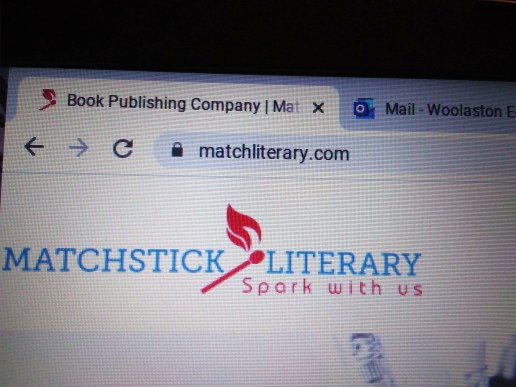
Here’s another thing: take a look at the picture I posted above. Notice the name of the company. Now look at the website’s address. They don’t match, do they? When you visit their site (and I’m not encouraging this, I’m just providing information that I found) there are pictures of book covers on their homepage. These are books they supposedly marketed and/or published. Many of these books were published by (wait for it) Xlibris, Author House, and iUniverse (which are all the same company). When I checked their sales stats on Amazon, I only found ONE title with any sales.

I’m sharing this, because as writers and authors, we have to be smart, otherwise, we will be grossly taken advantage of. There are no prices listed on Matchstick Literary’s site, for any of their services. That’s a serious red flag. Ask questions. Do some research. Check for reviews and complaints. And if something doesn’t feel right, don’t go through with it.

Woolaston Entertainment


Help! My Content Needs Updating!: A KDP Tip

As a self-published author, I don’t have the staff most publishing houses use. Traditional publishers have editors and graphic designers, and people who know how to handle marketing. I am a one woman show: I have to rely on my own editing skills, as well as act as my own graphic designer and do my own marketing. This means, I have to wear several hats. The upside of this, is I am constantly learning new ways to wear all three of those hats. 

Lately, I’ve had other writers ask me about publishing their books through Amazon, and how it compares to other self-publishing services I’ve encountered. I often compare Amazon’s service, KDP (Kindle Direct Publishing) to Xlibris, another well-known Print-On-Demand (or POD) publisher. Aside from pricing and creative control, a major difference is the author’s ability to update the content of their book. What does this mean? Let me explain.

Let’s say you’ve written your manuscript, and checked it and rechecked it for errors. You’ve read it so many times you’re literally sick of your own book. You upload it to KDP’s site, follow all of the steps, approve everything, and KDP publishes your book. It becomes available for sale on Amazon. You’re proud, as you should be! You order an “author copy” and read it when it arrives. Then, it happens: you find a typo. After all of that reading and editing and checking, there’s still a bloody typo. You’re thinking to yourself: “Oh, just end me already!” But all is not lost.

YOU CAN STILL UPLOAD NEW CONTENT FOR YOUR BOOK! Yes, if you make corrections to your manuscript, even after your book is published and Amazon has made it “live” on their site, you can still upload a updated version of your book’s content. You’re probably thinking, there must be some sort of time frame in which this has to be done. No, there isn’t. As long as the book is available on Amazon, you can update the content at any time. How do I know? I spotted a mistake in Our Lady of Righteous Rage: Extended and Uncensored, nearly three years after I published it. I made the correction, uploaded the updated manuscript, and all is well. 

Now, you’re probably wondering: Publishing with Amazon is free, but will I have to pay a fee when I update my book’s content? No. It’s still free.

Xlibris, on the other hand…

I published the first edition of Valentine with Xlibris in 2010. They sent me an author’s proof copy, so I could check for any errors. The first few mistakes were corrected for free. I was told, if any other changes needed to be made, there would be a fee. And this is after I had spent about $350 on a publishing package. And that was a sale, by the way. 

I’m not trying to tell you what to do. You’re your own person, with your own mind; you can decided for yourself. But I hope my personal experiences have offered some insight.

Woolaston Entertainment


Reading Your Book Out Loud

Remember kindergarten, when it was story time and your teacher would read a book out loud to your class? Or perhaps, for some of you, it was first grade. Maybe you had a parent read a book out loud to you. Either way, at some point, you were able to experience having a book read to you. If this never happened during your childhood, well, two things:

1) How sad.

2) Consider the audio book. It can be a wondrous thing.

speaking+out+loud

Reading something out loud can give the text itself a whole new meaning. It’s a combination of the material and the person reading. I mean, I couldn’t sit and just read Miriam Webster’s Dictionary, but I could listen to Tom Hiddleston read it out loud (there’s something about his voice, dude. It’s like ear-porn). Material sounds more interesting when its read out loud. If you’re writing a book, and you’re not sure how it will “sound” to your readers, try reading it out loud to yourself or to someone else.

I was on the fence about Our Lady of Righteous Rage, until I read it to myself, out loud. The material took on a different flow, and I actually came to appreciate it more. The same can be said for Novocaine. In fact, I have posted videos of myself on the Woolaston Entertainment Facebook page, reading samples from some of my books. 

Reading your material out loud can give you a better sense of how the words themselves flow. Maybe your main character’s speech about freedom isn’t as strong as it could be. Maybe that conversation that takes place between the husband and wife sounds a little too crude. Aside from learning how the material will “sound” to your readers, reading out loud is also a great editing tool.

Woolaston Entertainment

Snippet of “Our Lady of Righteous Rage: Extended and Uncensored”

PDF vs Word Doc: A Little KDP Tip

In all of the years that I have published books with Amazon’s KDP (formerly Create Space), I have learned many things through trial and error. When it comes to uploading a copy of your manuscript, two of your best choices for formats are PDF or a Word Document. However, I’ve learned this depends on if you’re publishing an ebook or a printed book. So, here’s my advice.

Use a PDF for Printed Books

As long as you have made all of your page breaks, it seems the best format to upload  a printed book, is a PDF. There’s a much better chance your book will retain all of its margins if you use a PDF. There’s nothing more annoying than looking at your print preview and seeing one heading on one page begin three or four lines lower than you intended, or seeing the beginning of a chapter start on the end of a page instead of the beginning. Also, when it comes to page numbers, you may want to have them start from a bottom  margin of at least 1.3. You can try 1.2, but that’s pushing it.

Use a Word Doc for Ebooks

It’s been my experience the good old fashioned Word Doc works just fine for ebooks. I’ve tried using PDF’s in the past, and even Amazon’s KDP advises against them. When it comes to ebooks and PDF’s, it seems the two just can’t get along. Your best bet is to upload your manuscript as a Word Doc. Even if you’re using Google Docs, download your manuscript as a Word Doc, then upload it.

NaNoWriMo: Creative Nonfiction

Greetings, folks! It’s still November, so it’s still NaNoWriMo. I hosted a Creative Nonfiction Workshop on Nov 14, for seven people (not bad for an introvert who doesn’t like speaking in front of groups, eh?)

We had a wonderful discussion about what CNF is, and we looked at some examples. Memoirs are among my favorite forms of CNF. I read Ray Bradbury’s Dandelion Wine when I was in middle school, and back then I had no idea it was actually a memoir from the author’s childhood. Stephen King, one of my favorite authors, uses a lot of his personal experiences in his writing. “The Body”, the short story that was adapted into the film, Stand By Me, is an example of this. When King was a child, he and his friends really did discover a dead body. 

Of course, not every CNF book is completely honest. Take for example, A Million Little Pieces by James Frey, published in 2003. This moving piece of literature about a man who overcomes alcohol and drug addiction won the hearts of readers all across America, including Oprah Winfrey. Oprah invited James to be a guest on her show. Eventually, someone did a little research, and exposed James as a fraud. Most of the info in the book was either made up or exaggerated. Instead of spending weeks in jail, he apparently only spent a few hours, and so on. 

Should CNF be honest? I’d like to think so. But the title of the genre is tricky. Creative makes you think along the lines of things that are made-up, while Nonfiction leads you to believe, the information is completely true. Put them together, and they almost sound like an oxymoron. CNF is telling a true story in a way that is engaging. It’s almost like the difference between a story on your local news channel, vs a story on Dateline.  Your local news will be very cut and dry, and straight forward. They give you the facts, and then they move on to the next story. Dateline, on the other hand, draws you in, and makes the details of the story more interesting. Sure, facts are still facts, but they’re being presented in a way that makes them interesting, and not just mere facts. 

If you’re considering writing a CNF of your own, here’s a list of great books to look at from Bookriot.com :

Creative Nonfiction Books

Have a happy NaNoWriMo!

What Do Your Characters Sound Like?

When you sit down to create a character, whether it’s for a book, short story, or a graphic novel/comic, what comes to mind? Your character’s appearance? Their behavior? What about their voice? What does your character sound like?

Every chapter is an episode, and I’m just watching them and writing all the details.

I mentioned this on a previous post, but I’ll say it again here. I’m a visual person. When I write, I picture the story taking place in my mind, and basically write what I see, the same as you would if you were watching a TV show or a movie and writing down all the events taking place. For me, Fortune’s Wing and Valentine aren’t just books, they’re TV series. Every chapter is an episode, and I’m just watching them and writing all the details. This means, all of my characters not only have a physical appearance, they have voices, too. So, I’m going to share some of the voices I hear, whenever one of my characters speak. This would serve as a potential cast list, of any of my books ever become animated movies or series.

Fortune Oyama of Fortune’s Wing: Leonardo DiCaprio. I dunno why, but each time I sat down to work on FW and I wrote Fortune’s dialogue, that’s the voice I heard.

Demetri of Fortune’s Wing: Orson Welles. Yes, I know he passed away in 1985, but he would have made a perfect Demetri. His voice also would have worked for John Rafferty of the Valentine series. Both characters are large men, and they’re both villains. I first heard Orson Welles’ voice in Transformers: The Movie (the animated one from 1986). He provided the voice for Unicron. I was enamored with how deep and booming his voice was, and he actually inspired both Demetri and Rafferty.

Valentine of Valentine: Charlize Theron’s voice has always been in my head for this character. She’s actually the reason I made Val so tall in the series (she’s between 5 foot 9 and 5 foot 10).

Dee Seybrook of Our Lady of Righteous Rage: Taraji P. Henson would HAVE to be the voice of Dee, if this book series became animated! Hands down! Her voice is perfect for Dee: the voice of a petite female who doesn’t take any crap.

Aidan Sirci of Our Lady of Righteous Rage: Ryan Renolds. Period. Tall, good looking, and sarcastic….pretty much describes Aidan, too!

Of course, your characters’ voices don’t have to belong to celebrities. Mine just happen to. Since I modeled Nyda Summit of Our Lady  after my mother, I tend to hear my mother’s voice when Nyda speaks. And Erin Michaels of Our Lady? That’s all me.

Woolaston Entertainment

What Makes a Good Spin-Off?

Spin-off: by definition, it is “a byproduct or incidental result of a larger project” or “a product marketed by its association with a popular television program, movie, personality, etc”. It’s not quite a sequel, but more of an extension of a smaller component of a larger creation. For example, there’s the sitcom, The Big Bang Theory, and its spin-off, Young Sheldon. The Big Bang Theory is the primary show, while Young Sheldon focuses on one character from Big Bang, Sheldon Cooper.

What makes a good spin-off? When it comes to books, I believe it helps to chose one of the most interesting characters or settings from the original book or series. Perhaps, a character the audience didn’t learn very much about in the original story. My Valentine series has led to two spin-offs: Valentine Apart and Lucia and the Saints (and I’m working out the details for a third series, Valentine R). The Apart series focuses on characters other than Valentine; characters the audience didn’t know much about, because the bulk of the series focuses mainly on Valentine herself. I chose the characters that seemed the most interesting, such as Lola Vencent and the Avery siblings. Her Name is Lola Vencent dives into Lola’s background, and her life before she worked for John Rafferty, while Allan and Mac depicts the events that took place before Allan and Mac met Valentine. While each character (or set of characters) received one stand-alone book, Jo Fuentes, another featured character from Valentine , will be the only character to have TWO books: Jo Fuentes The Black Queen and the upcoming Jo Fuentes Project Sleep. 

Spin-off’s need to be interesting. If a boring character, or one is just isn’t memorable is chosen, and all the details about them are boring, the audience will most likely lose interest. Readers like interesting backstories.

A good spin-off, should have a little foreshadowing. There need to be clues and events that connect the spin-off to the larger story. Lucia and the Saints is FILLED WITH FORESHADOWING. This series follows John Rafferty as he rises to become the “villain” readers know him to be in Valentine. It also follows the life of another important character, Lucia Milazzo, who ultimately helps Rafferty gain his power and position in the Syndicate.

There are other characters in Valentine that I could have chosen to use in Valentine Apart. Veronica, Val’s cousin, may have been a good candidate. However, since she and Val practically grew up together, and you learn more about both of them throughout the series, I felt it would have been a bit redundant. There’s also Melinda, the orphan Val rescues during her road trip to L.A. Melinda provides a brief recount of her life, prior to meeting Val, but since she’s only fourteen, I didn’t think there would be enough to tell about her, to fill a stand-alone book. But, Allan, Mac, Lola and Jo are all hitmen, with tragic backgrounds that make their stories interesting enough to appear in a stand-alone book.

Several characters make appearances in Lucia and the Saints, aside from Rafferty and Lucia. Vincent and Victor Entienne, Jacob Price, and Allan and Mac Avery, all had to start somewhere, and their entrance into the Syndicate is revealed in this series.

Jo Fuentes: Project Sleep is coming soon. The rest is available on Woolaston Entertainment’s site